Every score we publish is checked by independent judges, trained humans and a model held to their standard. When they disagree, the human wins and the model learns.
Where do you hear it?Not scored yet0 exact · 0 within one
You
Expert
Model
Step 01 · The Rubric, Published
Agreement Starts With A Definition
Grit
Sustained effort toward a goal, held through setbacks. One of the eight durable skills we measure. Below: what Grit sounds like at each level. Click a level to hear it in a real sentence.
One Voice, Read By The Rubric · Click The Levels Above
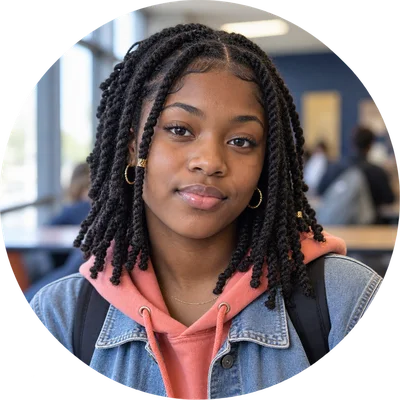
Nia
Grade 12 · Voice Prompt: Something You're Working On
“At first I kept messing up the routine and I wanted to quit, but I kept practicing it every nightuntil it finally clicked. Because I stuck with it, I made the team, and now when something is hard I remind myself it just takes reps.”
Step 02 · The Scoring Room
ML Score. Human Score. One Winner.
The working interface our raters use. This is science. Set the Human Score on each row, and where it differs, yours will win.
Student
Answer
ML Score
Human Score · You
Published
Step 03 · One Case, Start To Finish
When They Disagree, The Human Wins
You just ran the scoring room. Now slow one disagreement down. Take the call yourself: do you notice L2, or L3?
01The Model ReadsStart Below ↓
02You Make The CallYour Move ↓
03The Human Wins
04The Model Learns
Zaria
Grade 11 · Voice Prompt: The 10,000 Hours Rule
“My auntie always says quitters never win, so I guess I just don’t quit. Like last semester with algebra, everybody said drop it, and I stayed.”
The Model's Read
L2 · Developing
Detected a persistence verb, but classified “quitters never win” as a borrowed phrase, not first-person evidence.
Beat 02 · Your Call — Pick The Level You Hear
Beat 04 · Next Cycle — A Twin Case Arrives
Ishaan
Grade 10 · Voice Prompt: The 10,000 Hours Rule
“My grandpa always tells me slow is smooth, and honestly he’s right. When my science fair project kept failing, I rebuilt it three times until it worked.”
The Retrained Model's Read
L3 · Present
Same pattern — a borrowed phrase carrying lived persistence — now credited correctly, because a human corrected it.
Human ↔ Model · Agreement Restored
What Every Number Rests On
Every Number Begins With Something A Student Actually Said
Disagreement Is A Feature.
A system that never disagrees with itself is a system nobody is checking. Every divergence is surfaced and turned into training data.
Authority Flows One Direction.
Rubrics define the skill. Humans apply the rubric. The model is trained on their judgment and overruled by it. Every time, by design.
0.89
Human–Model κ
Experts agree with each other at κ 0.87 — the model sits inside the human range.
98.0%
Adjacent Agreement
Within one rubric level of the expert, on responses the model has never seen.
77.3%
Exact Agreement
Identical to the expert. Everything further apart is overruled by a human.
 Every score begins